Konica C35 value & buyer’s guide
bossFoto › Values › Konica C35
Camera · 1968–1974 · 35mm film
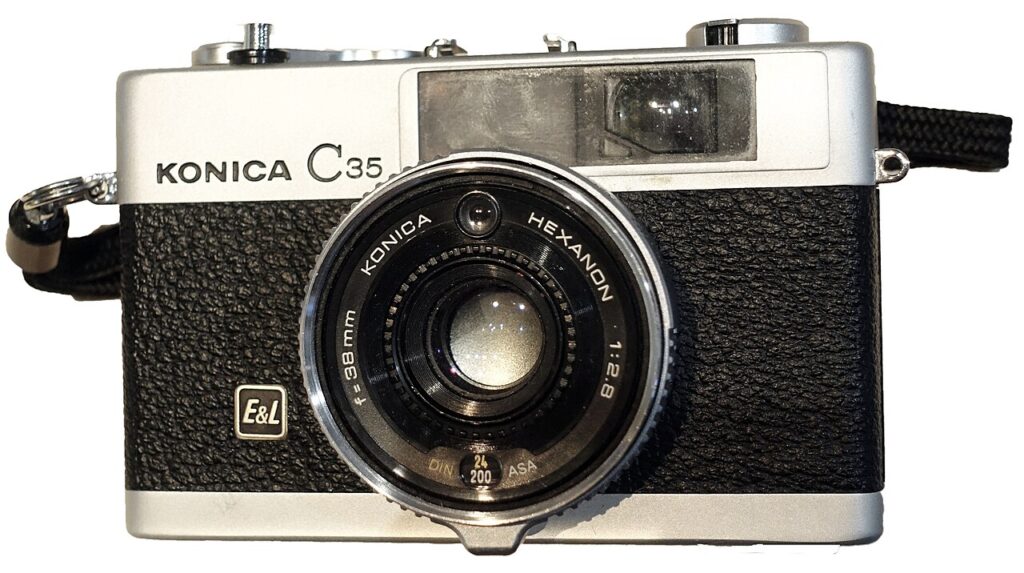

The Konica C35 is a groundbreaking compact 35mm rangefinder camera renowned for popularizing pocketable, automatic film photography. It is highly sought after by film enthusiasts for its sharp 4-element Hexanon 38mm f/2.8 lens, reliable programmed exposure system, and tactile metal build.
How to identify a Konica C35
Recognized by its small rectangular aluminum body with a front cell light meter window integrated directly into the lens thread ring. The model name Konica C35 is printed on the front top plate, and serial numbers are stamped into the bottom plate. It is commonly confused with non-rangefinder zone-focus models like the C35 V/E&L or later plastic point-and-shoots like the C35 EF and AF.
Versions and how to tell them apart
| Version | Years | How to tell |
|---|---|---|
| Konica C35 (Original) | 1968–1971 | Standard lens barrel lacking an integrated flash guide number calculation ring. |
| Konica C35 Automatic / Flashmatic | 1971–1974 | Lens barrel includes a dedicated guide number ring for automatic flash aperture coupling. |
What to check before buying
- Verify light meter needle movement inside the viewfinder when pointing the camera toward light and dark areas.
- Inspect shutter and aperture blades for oil residue, sluggish movement, or sticking.
- Check the battery compartment for blue-green corrosion and inspect battery wire integrity under the bottom plate.
- Look through the viewfinder to ensure the rangefinder patch is clear, aligned vertically, and merges properly at infinity.
- Inspect the Hexanon 38mm lens for internal haze, fungus, glass scratches, or element separation.
- Open the film door to inspect the condition of the foam light seals along the hinge and channels.
- Test the film advance lever, shutter button release, and mechanical frame counter for smooth operation.
Known issues
- Battery compartment wire corrosion from leaked mercury batteries leading to complete light meter failure.
- Sticky or oil-contaminated Copal shutter blades that freeze or fail to actuate reliably.
- Hazy or desilvered rangefinder beam-splitter prisms reducing contrast in the focusing patch.
- Inaccurate exposure metering caused by using 1.5V alkaline batteries instead of 1.35V cells without recalibration.
- Deteriorated rubber or foam light seals causing film door light leaks.
What affects the price
- Film-tested functionality and recent light seal replacement add notable value.
- Original lens cap, neck strap, case, and original box boost collectible value.
- Rare factory black anodized finish commands a premium over standard silver chrome bodies.
- Corrosion-free battery compartments and calibrated light meters increase overall desirability.
Specifications
| Lens | Hexanon 38mm f/2.8 (4 elements in 3 groups) |
|---|---|
| Focusing | Coupled split-image rangefinder (1.0 m / 3.3 ft to infinity) |
| Shutter | Copal B Mat programmed automatic leaf shutter (1/30s to 1/650s plus Bulb) |
| Exposure Metering | Lens-barrel CdS cell with programmed automatic exposure (EV 8 to EV 17) |
| ISO Speed Range | ASA 25 to 400 (DIN 15 to 27) |
| Battery Requirement | 1x 1.35V PX675 mercury cell (uses 1.4V zinc-air 675 or adapted SR44) |
| Viewfinder | Bright-frame optical finder with shutter speed/aperture needle scale |
| Dimensions & Weight | 112 x 70 x 52 mm; approx. 380 g |
Questions people ask
Is the Konica C35 worth buying today?
Yes, the Konica C35 remains one of the best budget compact rangefinder film cameras available. Its sharp Hexanon 38mm f/2.8 lens delivers excellent contrast and rendering, while its tiny footprint makes it ideal for street and everyday carry photography.
What battery and film does the Konica C35 take?
The camera accepts standard 35mm film rolls (ISO 25 to 400). It was originally powered by a 1.35V PX675 mercury battery; today, it works best with 1.4V zinc-air hearing aid batteries (size 675) or silver-oxide SR44 cells paired with a voltage drop adapter.
How does the Konica C35 compare to the Olympus Trip 35?
While both feature compact metal bodies and sharp 38mm f/2.8 lenses, the Konica C35 uses a true coupled rangefinder for precise manual focusing, whereas the Trip 35 relies on zone focusing. Additionally, the C35 requires a battery for its CdS meter, while the Trip 35 uses a battery-free selenium light meter.
How can I check if a Konica C35 light meter and shutter are working?
Insert a working battery and look through the viewfinder. Point the camera at a bright light source and half-press the shutter; the meter needle on the right side should move into the upper aperture/speed range. Point it toward a dim corner, and the needle should drop toward the lower speeds.
Have one in front of you? bossFoto reads the engravings in a few photos, tells you the exact version, grades the condition and gives you a value.
Scan it with bossFoto →Sources
Related guides
Canon A-1 · Canon AE-1 Program · Canon AE-1 · Canon AV-1 · Canon Canonet QL17 GIII · Canon EOS 3 · Canon EOS 5D Mark II · Canon EOS 5D Mark III
Prices are estimates from recent sold listings and move over time. Condition, completeness and the exact version matter, so check an item in person before paying. Last checked November 2026.