Canon FD 50mm f/1.4 value & buyer’s guide
bossFoto › Values › Canon FD 50mm f/1.4
Lens · 1971–1986 · 35mm film · Canon FD mount
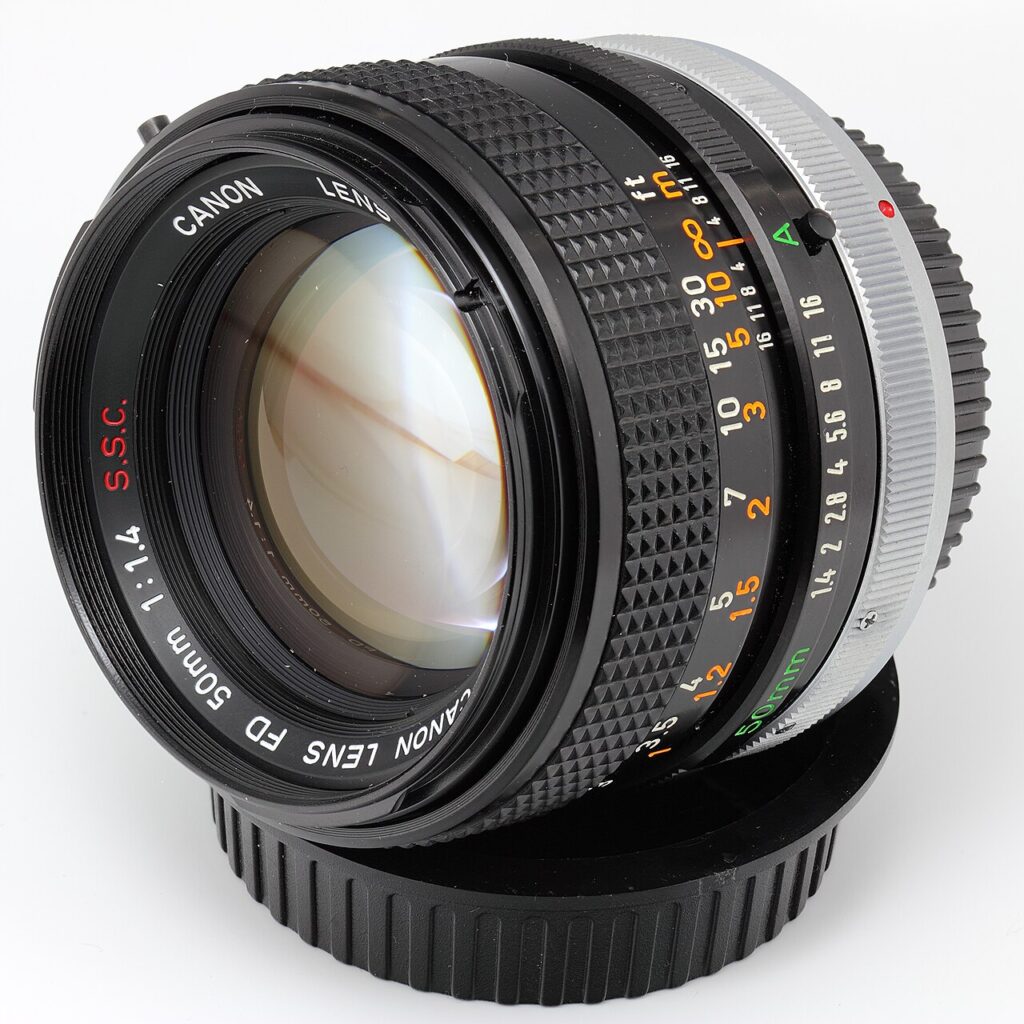

The Canon FD 50mm f/1.4 is a classic fast standard prime lens renowned for its sharp optical performance, warm color reproduction, and smooth bokeh. It was a flagship standard lens for Canon's 35mm SLR bodies and has become one of the most popular vintage prime lenses to adapt onto modern digital mirrorless cameras.
How to identify a Canon FD 50mm f/1.4
It is recognized by its prominent manual focus ring, front markings indicating focal length and maximum aperture, and metallic or black breech lock/bayonet mount. The lens designation and serial number are engraved around the front element retaining ring. It is often confused with the older Canon FL 50mm f/1.4 or the slower Canon FD 50mm f/1.8.
Versions and how to tell them apart
| Version | Years | How to tell |
|---|---|---|
| FD 50mm f/1.4 (Chrome Nose) | 1971–1973 | Silver metal filter ring at the front rim and silver breech-lock ring at the mount base. |
| FD 50mm f/1.4 S.S.C. | 1973–1979 | All-black front barrel with Super Spectra Coating designation ('S.S.C.') engraved on the front ring and a 55mm filter diameter. |
| New FD (nFD) 50mm f/1.4 | 1979–1986 | Lightweight body with a square silver metal release button on the mount rather than a rotating breech-lock collar, and a smaller 52mm filter thread. |
What to check before buying
- Inspect internal glass elements with a penlight for fogging, haze, or fungal growth.
- Operate the manual focus ring across its full travel to check for smooth rotation without gritty spots.
- Examine the aperture blades for traces of oil migration or residue.
- Test the aperture mechanism and stop-down lever manually to ensure the diaphragm snaps open and closed instantly.
- Verify that the mount locking mechanism (breech-lock ring or nFD release button) operates securely without wobble.
- Check front and rear glass surfaces for micro-scratches or damage to optical coatings.
- Look at front filter threads to ensure they are free of dents and cross-threading.
Known issues
- Oil migration onto diaphragm blades causing sluggish aperture movement.
- Internal haze accumulation on middle glass elements from aging lubricants during long storage.
- Drying of helicoid grease resulting in stiff or uneven focus ring movement.
- Loose exterior barrel play on high-mileage plastic nFD housings.
What affects the price
- Optical clarity: clean glass free of internal haze, fungus, or element separation commands peak prices.
- Mechanical health: snappy oil-free aperture blades and smooth focus helicoid movement add value.
- Version type: lightweight nFD models are preferred for compact setups, while all-metal S.S.C. models are sought after for robust build quality.
- Included original accessories like Canon lens caps, original BS series lens hood, or original box.
Specifications
| Focal Length | 50mm |
|---|---|
| Maximum Aperture | f/1.4 |
| Minimum Aperture | f/16 |
| Optical Construction | 7 elements in 6 groups |
| Aperture Blades | 8 |
| Minimum Focus Distance | 0.45 m (1.5 ft) |
| Filter Thread Size | 55mm (FD / S.S.C.) / 52mm (nFD) |
| Weight | approx. 235g (nFD) to 350g (S.S.C.) |
| Mount Type | Canon FD |
Questions people ask
Is the Canon FD 50mm f/1.4 worth buying today?
Yes, it offers an exceptional balance of price, optical sharpness, and fast f/1.4 low-light capability, making it one of the best value vintage prime lenses for film shooters and digital mirrorless video creators.
Can I use the Canon FD 50mm f/1.4 on digital cameras?
Yes, it adapts easily to modern mirrorless systems like Sony E, Canon RF, Fujifilm X, Nikon Z, and Micro Four Thirds using simple mechanical adapters. However, adapting to digital DSLRs like Canon EF or Nikon F requires glass-corrected adapters that reduce optical quality.
How does the FD 50mm f/1.4 compare to the FD 50mm f/1.8?
The f/1.4 version provides nearly a full stop more light-gathering power, tighter control over depth of field, richer multi-layer optical coatings (S.S.C.), and generally higher build quality compared to the standard f/1.8 kit lens.
How do I check if the aperture diaphragm is working when off the camera?
Because Canon FD lenses keep the aperture wide open by default, you must manually push and lock the rear stopped-down lever on the mount (or mount the lens onto an adapter) before turning the aperture ring to see the blades open and close.
Have one in front of you? bossFoto reads the engravings in a few photos, tells you the exact version, grades the condition and gives you a value.
Scan it with bossFoto →Sources
Related guides
Canon A-1 · Canon AE-1 Program · Canon AE-1 · Canon AV-1 · Canon Canonet QL17 GIII · Canon EF 50mm f/1.8 STM · Canon EF 70-200mm f/2.8L IS II USM · Canon EOS 3
Prices are estimates from recent sold listings and move over time. Condition, completeness and the exact version matter, so check an item in person before paying. Last checked November 2026.