Gossen Lunasix 3 value & buyer’s guide
bossFoto › Values › Gossen Lunasix 3
Accessory · 1966–1977 · n/a · none mount
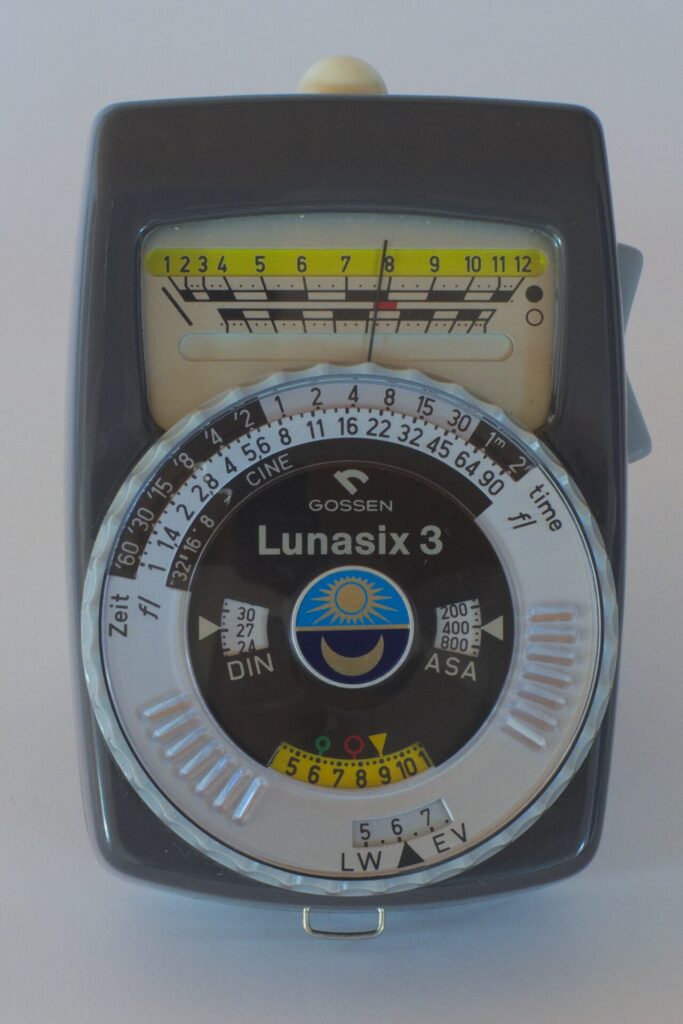

The Gossen Lunasix 3 is a heavy-duty analog light meter renowned for its high accuracy and extreme low-light sensitivity down to -4 EV. It measures both reflected and incident ambient light using an intuitive dual-scale readout and a mechanical needle-lock mechanism. Photographers value it today as a durable, precision light meter for film and digital exposure calculation.
How to identify a Gossen Lunasix 3
Recognised by its charcoal-grey rectangular body, large circular exposure calculator dial, and a sliding white hemispherical diffuser dome on top. The name 'Lunasix 3' (or 'Luna-Pro' on North American models) is printed on the front dial plate, with the serial number on the rear casing or inside the battery chamber. It is often confused with the original 1961 Lunasix, which lacked accessory attachment mounting tracks, or the later Lunasix 3S, which added an orange slider lock switch.
What to check before buying
- Verify needle movement and responsiveness by pointing the cell toward bright and dim light sources.
- Inspect the screw-cap battery compartment for corrosion or green chemical leakage from vintage mercury cells.
- Perform a zero-position test without batteries installed to check if the needle rests precisely on the zero mark.
- Slide the white incident diffuser dome back and forth to ensure it clicks smoothly into both incident and reflected positions.
- Rotate the circular calculator dial to confirm all aperture and shutter speed scales turn freely without grinding.
- Test the rocker selector switch in both forward (low light) and backward (high light) positions to check scale switching.
- Slide the dedicated battery test switch without pressing the rocker to verify the needle swings into the red check zone.
Known issues
- CdS cell memory effect causes temporary reading lag when moving from bright daylight into dark shadow areas.
- Requires obsolete 1.35V mercury batteries; unadapted 1.5V alkaline or silver-oxide cells introduce exposure errors.
- Internal calibration potentiometers can drift over decades, causing measurement discrepancies between high and low light scales.
- Internal electrical wiring to the battery terminals can become brittle or corrode over time, causing intermittent power loss.
What affects the price
- Inclusion of an official Gossen voltage-reducing battery adapter or modern 1.55V recalibration increases value.
- System attachments such as the 7.5°/15° Variable Angle Tele attachment, Enlarging attachment, or Microscope attachment add value.
- Clean cosmetic condition with sharp dial markings and a clear meter glass window raises pricing.
- Original fitted leather protective case and neck strap enhance resale value.
Specifications
| Maker | Gossen (Germany) |
|---|---|
| Sensor Type | Cadmium Sulfide (CdS) photoresistor |
| Metering Modes | Reflected light (30° acceptance angle) and Incident light |
| Measuring Range | EV -4 to EV +18 at ISO 100/21° |
| ISO Range | ASA 0.8 to 25,000 (DIN 0 to 45) |
| Aperture Range | f/1.0 to f/90 |
| Shutter Speed Range | 1/4000s to 8 hours |
| Original Battery | Two 1.35V PX13 / V625PX mercury button cells |
| Dimensions | 100 x 70 x 35 mm |
| Weight | 189 g |
Questions people ask
Is the Gossen Lunasix 3 worth buying for film photography today?
Yes, it remains a reliable, precise, and highly sensitive exposure meter that excels in extreme low-light environments down to -4 EV. With an appropriate battery solution, its needle-freeze mechanism and wide dial scales make it a practical tool for medium format, large format, and analog studio work.
What battery does the Gossen Lunasix 3 use and how do I power it today?
The meter originally ran on two 1.35V PX13 or V625PX mercury cells, which are discontinued. Today, you can power it using an official Gossen voltage-reducing adapter with SR43 silver-oxide batteries, 1.4V zinc-air hearing aid batteries with rubber O-ring spacers, or by having an technician recalibrate the internal resistors for standard 1.55V cells.
How does the Lunasix 3 compare to the later Gossen Profisix or Luna-Pro SBC?
The Lunasix 3 uses a CdS photoresistor and a dual-scale rocker switch, while the Profisix and Luna-Pro SBC use faster Silicon Blue Cells (SBC) with a zero-center null readout. The SBC models do not suffer from CdS memory lag and run on standard 9V batteries, but the Lunasix 3 is more compact, requires no standby battery draw, and is generally more affordable.
How do I test if a used Gossen Lunasix 3 is working properly?
Remove the batteries and press the selector switch to verify the needle aligns with the mechanical zero mark on the left edge. Next, install powered batteries, engage the battery test switch to check if the needle reaches the red zone, and then test ambient readings to verify the needle moves smoothly across both low and high light ranges and freezes when the rocker switch is released.
Have one in front of you? bossFoto reads the engravings in a few photos, tells you the exact version, grades the condition and gives you a value.
Scan it with bossFoto →Sources
Related guides
Canon Power Winder A · Fujifilm Instax Mini Link 2
Prices are estimates from recent sold listings and move over time. Condition, completeness and the exact version matter, so check an item in person before paying. Last checked November 2026.