Mamiya RB67 Pro S value & buyer’s guide
bossFoto › Values › Mamiya RB67 Pro S
Camera · 1974–1990 · 120 film (6x7 cm) · Mamiya RB bayonet mount
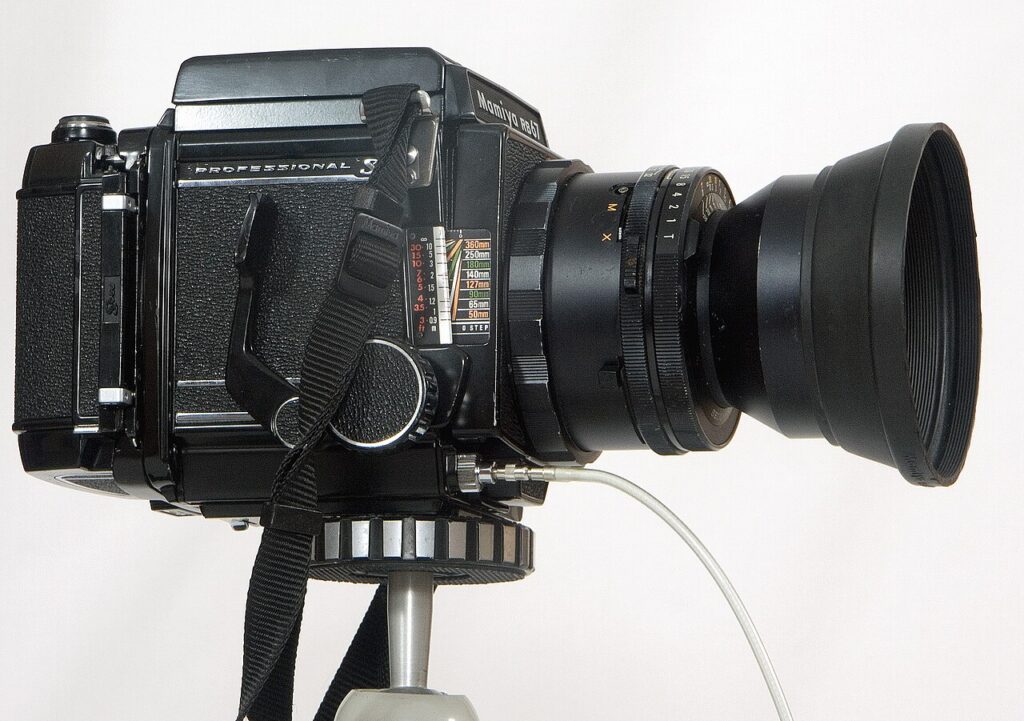

The Mamiya RB67 Pro S is a legendary mechanical 6x7 medium-format SLR system camera celebrated for its revolving back design, leaf-shutter lenses, and modular flexibility. Studio, portrait, and landscape photographers favor it today for producing large, sharp 6x7 negatives without reliance on camera batteries.
How to identify a Mamiya RB67 Pro S
The camera is identified by the 'Mamiya RB67 PRO S' badge located on the front upper housing above the lens mount and stamped onto its matching roll film backs. The serial number is engraved on the upper side of the main body body shell near the viewfinder mounting rails. It is commonly confused with the original 1970 RB67 Professional or the later RB67 Pro SD, but can be distinguished by the 'S' designation, red viewfinder orientation indicator flags, and double-exposure interlock controls.
Versions and how to tell them apart
| Version | Years | How to tell |
|---|---|---|
| RB67 Professional | 1970–1974 | Original camera body marked 'Mamiya RB67' without an 'S' suffix, lacking red viewfinder orientation indicators and the double-exposure prevention interlock. |
| RB67 Professional S (Pro S) | 1974–1990 | Engraved 'PRO S' on front plate; introduced a double-exposure interlock switch, focus lock lever, self-erecting waist-level finder hood, and automatic viewfinder orientation frame lines. |
| RB67 Professional SD (Pro SD) | 1990–2004 | Engraved 'PRO SD' on front plate; features an enlarged 61mm mount throat for wider-aperture lenses and light-trap film backs that eliminate traditional foam light seals. |
What to check before buying
- Extend the focusing bellows completely in a dark room and shine a bright light inside to check for pinholes, tears, or cracking in the leatherette folds.
- Fire the lens leaf shutter at all speeds to ensure the shutter blades open and close cleanly without sticking, lagging, or oil residue.
- Rotate the revolving back mechanism between horizontal and vertical orientations to confirm smooth 90-degree turning and solid locking.
- Inspect the light seals along the revolving adapter, camera back interface, and film cassette door for crumbling or sticky foam degradation.
- Push the main side cocking lever down to verify that it smoothly cocks both the body mirror mechanism and the internal lens shutter simultaneously.
- Verify the operation of the double-exposure interlock lever on the roll film back and ensure film advances smoothly frame by frame.
- Turn both focusing knobs to confirm smooth rack-and-pinion movement across the entire rail length and check that the focus lock lever holds firm.
Known issues
- Deteriorated foam light seals inside the revolving back adapter and film holders, causing light leaks on film negatives.
- Sluggish or frozen leaf shutters inside Sekor lenses due to hardened internal lubricants or oil on shutter blades.
- Pinholes or fabric separation along bellows corners caused by aged rubberized canvas or heavy folding wear.
- Loose or slipping rack-and-pinion focusing gears caused by worn internal teeth or loose mounting hardware.
- Stuck double-exposure interlock linkage preventing the shutter from releasing or locking the film advance mechanism.
What affects the price
- Physical condition of internal focusing bellows and whether foam light seals have been recently replaced.
- Optical quality and series of the included lens (multi-coated Sekor C and K/L lenses carry higher market value).
- Inclusion of desirable modular accessories like CdS prism finders, dual-grip handles, or extra 120 film backs.
- Overall cosmetic state of body metalwork, paint finish, and smooth gear engagement.
Specifications
| Frame Format | 6x7 cm (56 x 72 mm actual frame size) on 120 film (10 exposures) |
|---|---|
| Shutter Type | Mechanical Seiko No. 1 leaf shutter in lens, speeds 1 to 1/400 sec plus T (Time) |
| Flash Sync | Full flash synchronization (X-sync) at all shutter speeds (1 to 1/400 sec) via PC terminal |
| Focusing System | Dual rack-and-pinion bellows extension with maximum 46mm travel |
| Batteries Required | None (fully mechanical operation; non-metered finders require no power) |
| Viewfinder | Interchangeable waist-level finder with pop-up magnifier (prism finders available) |
| Lens Mount | Mamiya RB bayonet mount (54mm throat diameter) |
| Weight | Approx. 2.7 kg / 6.0 lbs (with 90mm f/3.8 lens, waist-level finder, and 120 film back) |
| Dimensions | 104 x 144 x 228 mm (complete body with finder, back, and standard lens) |
Questions people ask
Is the Mamiya RB67 Pro S worth buying today?
Yes, it remains one of the most reliable and affordable pathways into 6x7 medium-format photography. Because it is completely mechanical, it avoids obsolete electronic failures, and its leaf-shutter lenses offer full studio flash sync at all shutter speeds up to 1/400 second.
What film and battery does the Mamiya RB67 Pro S take?
The RB67 Pro S is entirely mechanical and requires no batteries to operate standard body functions or waist-level viewfinders. It takes 120 roll film, producing ten 6x7 format negatives per roll when using standard 120 film backs.
How does the Mamiya RB67 Pro S compare to the Mamiya RZ67?
The RB67 Pro S is fully mechanical and bellows-focused, whereas the RZ67 relies on electronic shutters and requires a battery to function. The RZ67 offers shorter cocking throw and electronic integration, but the RB67 is widely considered more durable and independent of battery availability in the field.
How do you check if a used Mamiya RB67 Pro S is working correctly?
Cock the main side lever downward to tension both mirror and lens shutter mechanisms. Ensure the dark slide is removed from the film back, then trip the shutter release button and check that the leaf shutter fires crisply. Rotate the film back 90 degrees to confirm that internal viewfinder red orientation flags move, and inspect the extended bellows for pinholes using a flashlight inside a dark room.
Have one in front of you? bossFoto reads the engravings in a few photos, tells you the exact version, grades the condition and gives you a value.
Scan it with bossFoto →Sources
Related guides
Canon A-1 · Canon AE-1 Program · Canon AE-1 · Canon AV-1 · Canon Canonet QL17 GIII · Canon EOS 3 · Canon EOS 5D Mark II · Canon EOS 5D Mark III
Prices are estimates from recent sold listings and move over time. Condition, completeness and the exact version matter, so check an item in person before paying. Last checked November 2026.