Olympus OM-1 value & buyer’s guide
bossFoto › Values › Olympus OM-1
Camera · 1972–1987 · 35mm film · Olympus OM mount
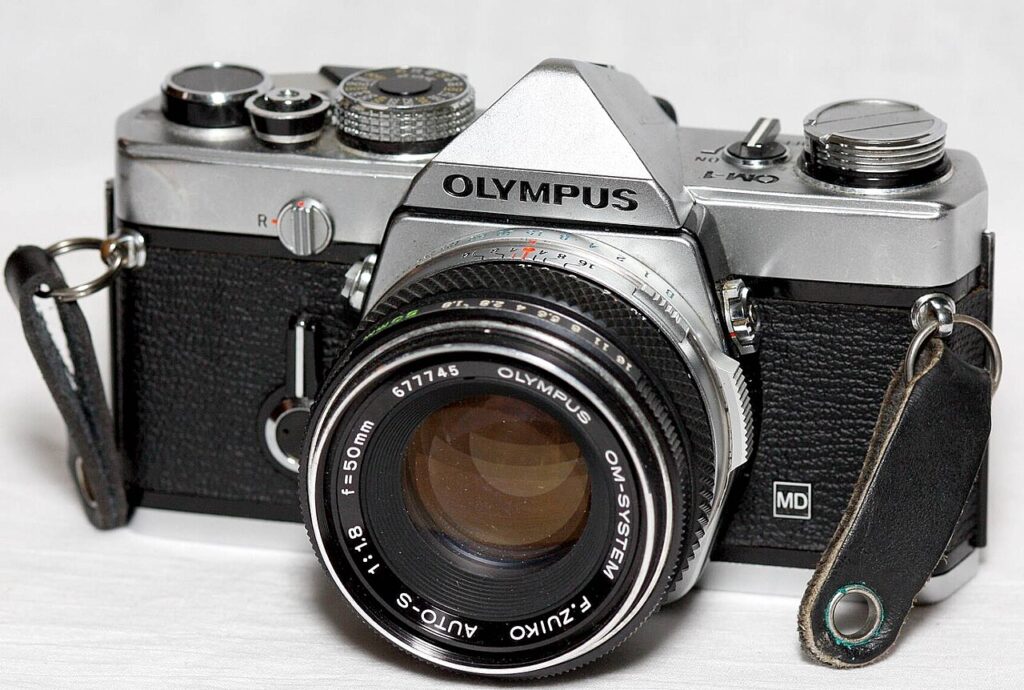

The Olympus OM-1 is a legendary manual-focus 35mm mechanical SLR camera famous for drastically reducing camera body size while maintaining professional durability. Photographers value it today for its large, bright 0.92x viewfinder, fully battery-independent mechanical shutter, and access to compact, high-quality Zuiko lenses.
How to identify a Olympus OM-1
It is recognized by its ultra-compact classic body style, standard silver-and-black trim, and unique shutter speed selection ring positioned around the lens mount rather than on the top plate. Model markings appear on the front shoulder above the lens mount, and the serial number is engraved on the top plate behind the film rewind crank. It is sometimes confused with the electronic OM-2 or modern digital OM System mirrorless bodies.
Versions and how to tell them apart
| Version | Years | How to tell |
|---|---|---|
| Olympus M-1 | 1972–1973 | Marked M-1 on the front left shoulder above the lens mount and features a plain bottom plate without motor drive ports. |
| Olympus OM-1 | 1973–1974 | Marked OM-1 on the front shoulder with a smooth bottom plate lacking motor drive drive sockets. |
| Olympus OM-1 MD | 1974–1979 | Features a small circular MD badge on the front lower right shoulder and removable caps for motor drive couplings on the bottom plate. |
| Olympus OM-1n | 1979–1987 | Engraved OM-1n on the front shoulder, with a reshaped film advance lever tip and internal flash readiness signal in the viewfinder. |
What to check before buying
- Look through the viewfinder for dark, jagged corrosion spots along the bottom edge, indicating decaying pentaprism dampening foam.
- Fire all mechanical shutter speeds from 1 second to 1/1000 second to ensure the cloth curtains travel smoothly.
- Inspect the battery compartment for acid corrosion and check if the light meter needle responds to brightness changes when switched on.
- Examine the film compartment seals and mirror bumper foam for sticky, degrading rubber that requires replacement.
- Test the mirror lock-up switch located beside the lens mount to ensure the reflex mirror swings up and returns cleanly.
- Engage the mechanical self-timer lever to verify it runs smoothly without jamming the shutter release.
- Operate the film advance lever and frame counter to confirm smooth film transportation.
Known issues
- Pentaprism silvering degradation caused by old internal dampening foam breaking down into acidic goo.
- Discontinued 1.35V mercury PX625 battery requirement, causing the light meter to read inaccurately with standard 1.5V batteries unless adapted or recalibrated.
- Deteriorated film door light seals and mirror dampening foam leading to light leaks.
- Sluggish slow shutter speeds (1s and 1/2s) due to aged or dried internal lubricants.
What affects the price
- Clean pentaprism optics free from foam rot or silvering corrosion.
- Early original M-1 production variants or clean OM-1n models command premium collector interest.
- Documented recent professional servicing (CLA) or voltage conversion for modern batteries.
- Bundling with desirable fast prime lenses such as the Zuiko 50mm f/1.4 or f/1.8.
Specifications
| Type | 35mm single-lens reflex (SLR) |
|---|---|
| Shutter | Mechanical horizontal cloth focal-plane shutter |
| Shutter Speeds | 1/1000s to 1s plus Bulb |
| Exposure Metering | TTL center-weighted CdS match-needle meter |
| Original Battery | 1.35V PX625 mercury cell (light meter only) |
| Viewfinder | Pentaprism with 0.92x magnification and 97% frame coverage |
| Focusing Screens | Interchangeable focusing screens |
| Dimensions | 136 x 83 x 50 mm |
| Weight | Approximately 510 g (body only) |
Questions people ask
Is the Olympus OM-1 worth buying today?
Yes, it is widely considered one of the best manual 35mm film SLRs ever built, celebrated for its exceptionally large viewfinder, fully mechanical operation independent of batteries, superb ergonomics, and access to outstanding Zuiko lenses.
What battery and film does the Olympus OM-1 take?
It uses standard 35mm (135) film. The mechanical shutter does not need a battery to operate, but the light meter originally required a 1.35V PX625 mercury battery. Today, photographers use 625 zinc-air cells, voltage-reducing MR-9 adapters with silver-oxide button cells, or modified internal circuitry for modern 1.5V batteries.
How does the Olympus OM-1 compare to the Nikon FM or Canon AE-1?
Unlike the Canon AE-1, which requires battery power to operate its electronic shutter, the OM-1 is fully mechanical. Compared to the mechanical Nikon FM, the OM-1 provides a significantly larger and brighter 0.92x viewfinder, a unique shutter ring around the lens mount, and a lighter, more compact body.
How can I test if a used Olympus OM-1 works properly?
Cycle through all shutter speeds while listening for even timing, check inside the viewfinder for dark foam marks along the bottom edge, test the film advance lever for smooth resistance, and verify light meter movement against a smartphone meter app using a suitable battery.
Have one in front of you? bossFoto reads the engravings in a few photos, tells you the exact version, grades the condition and gives you a value.
Scan it with bossFoto →Sources
Related guides
Canon A-1 · Canon AE-1 Program · Canon AE-1 · Canon AV-1 · Canon Canonet QL17 GIII · Canon EOS 3 · Canon EOS 5D Mark II · Canon EOS 5D Mark III
Prices are estimates from recent sold listings and move over time. Condition, completeness and the exact version matter, so check an item in person before paying. Last checked November 2026.