Olympus Trip 35 value & buyer’s guide
bossFoto › Values › Olympus Trip 35
Camera · 1967–1984 · 35mm film
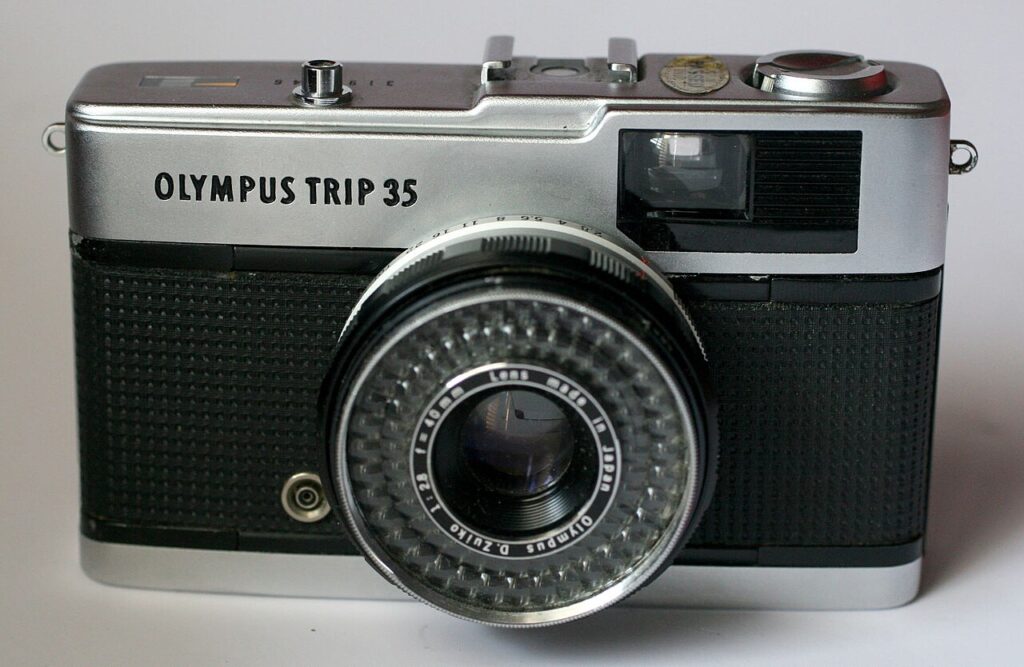

The Olympus Trip 35 is an iconic, battery-free 35mm compact camera featuring a sharp 40mm f/2.8 D. Zuiko lens and a solar-powered selenium light meter. It is widely sought after by film beginners and street photographers for its effortless point-and-shoot operation, rugged metal construction, and rich image quality.
How to identify a Olympus Trip 35
It is easily recognized by the ring of textured selenium light-meter cells surrounding the front glass of its 40mm f/2.8 lens and its compact metal body. The model name 'Olympus Trip 35' is engraved on the top plate, while the serial number is stamped on the bottom plate near the tripod socket. It is sometimes confused with Olympus Pen half-frame cameras like the Pen EES, which share a similar selenium ring design but record smaller half-frame images.
What to check before buying
- Test auto exposure in bright light: half-press the shutter in 'A' mode to ensure the shutter fires smoothly without triggering the low-light red flag.
- Test low-light safety lock: cover the lens completely with your hand in 'A' mode and press the shutter; a red plastic flag must pop up in the viewfinder and lock the shutter release.
- Inspect the selenium light meter ring: verify that the honeycomb pattern around the lens is intact and free of cracks or discoloration.
- Examine aperture blade movement: turn the ring through manual flash aperture settings (f/2.8 to f/22) to confirm the aperture blades open and close briskly without oil spots.
- Check the film advance thumbwheel: cock and release the shutter several times to ensure smooth film winding without grinding or binding.
- Inspect foam light seals: inspect the internal film door channels and door hinge area for sticky, degraded, or missing foam light seals.
- Verify zone focus ring: turn the front focus ring to ensure all four icon click-stops feel distinct and rotate freely.
Known issues
- Sticky or oil-contaminated aperture blades that fail to actuate during exposure.
- Exhausted or dead selenium light cells resulting in a permanently locked shutter or incorrect auto exposure.
- Stuck or broken red flag low-light mechanism due to dried internal grease or bent mechanical linkages.
- Deteriorated door foam light seals leading to light leaks on exposed film.
- Wobbly lens assembly or loose focus barrel caused by backed-out internal mounting screws.
What affects the price
- A fully operational selenium light meter and responsive red-flag mechanism significantly increase camera value.
- Recent professional CLA (clean, lube, adjust) service and fresh light seals add a substantial premium over raw thrift finds.
- Cosmetic condition of the chrome metal body plates and optical clarity of the lens (free of haze, scratches, or fungus).
- Inclusion of original accessories like the lens cap, wrist strap, or leather pouch.
Specifications
| Lens | Fixed 40mm f/2.8 D. Zuiko (4 elements in 3 groups) |
|---|---|
| Film Format | 35mm film (24×36mm standard full frame) |
| Focusing System | 4-position zone focus (1m, 1.5m, 3m, infinity) |
| Shutter Speeds | Programmed 1/40s and 1/200s (fixed 1/40s in manual flash mode) |
| Aperture Range | f/2.8 to f/22 (automatic program or manual selection) |
| Exposure Metering | Solar-powered selenium cell ring (battery-free) |
| ISO/ASA Setting | ISO 25 to 400 (manually set via lens barrel ring) |
| Flash Connection | Hot shoe and PC sync terminal |
| Filter Thread | 43.5mm |
| Dimensions & Weight | 124 × 72 × 57 mm, approximately 390 g |
Questions people ask
Is the Olympus Trip 35 worth buying today?
Yes, the Olympus Trip 35 remains one of the best budget 35mm film cameras available. It combines sharp optics with simple point-and-shoot operation and completely battery-free functionality, provided you verify that the light meter and shutter lock are fully operational.
What battery and film does the Olympus Trip 35 take?
The Trip 35 does not require any batteries because its exposure meter is powered by a solar selenium cell surrounding the lens. It uses standard 35mm film cassettes rated between ISO 25 and 400.
How does the Olympus Trip 35 compare to the Olympus Pen EES?
Although both cameras feature similar selenium light meters and zone focus controls, the Pen EES is a half-frame camera yielding 72 small shots on a 36-exposure roll, whereas the Trip 35 captures full-frame 24x36mm exposures.
How can I check if an Olympus Trip 35 light meter works properly?
Set the lens aperture ring to 'A', cover the selenium glass ring completely with your hand, and press the shutter button. If the meter works, a red plastic warning flag will pop up in the viewfinder and lock the shutter; when pointed at bright light, the camera should fire normally without raising the red flag.
Have one in front of you? bossFoto reads the engravings in a few photos, tells you the exact version, grades the condition and gives you a value.
Scan it with bossFoto →Sources
Related guides
Canon A-1 · Canon AE-1 Program · Canon AE-1 · Canon AV-1 · Canon Canonet QL17 GIII · Canon EOS 3 · Canon EOS 5D Mark II · Canon EOS 5D Mark III
Prices are estimates from recent sold listings and move over time. Condition, completeness and the exact version matter, so check an item in person before paying. Last checked November 2026.