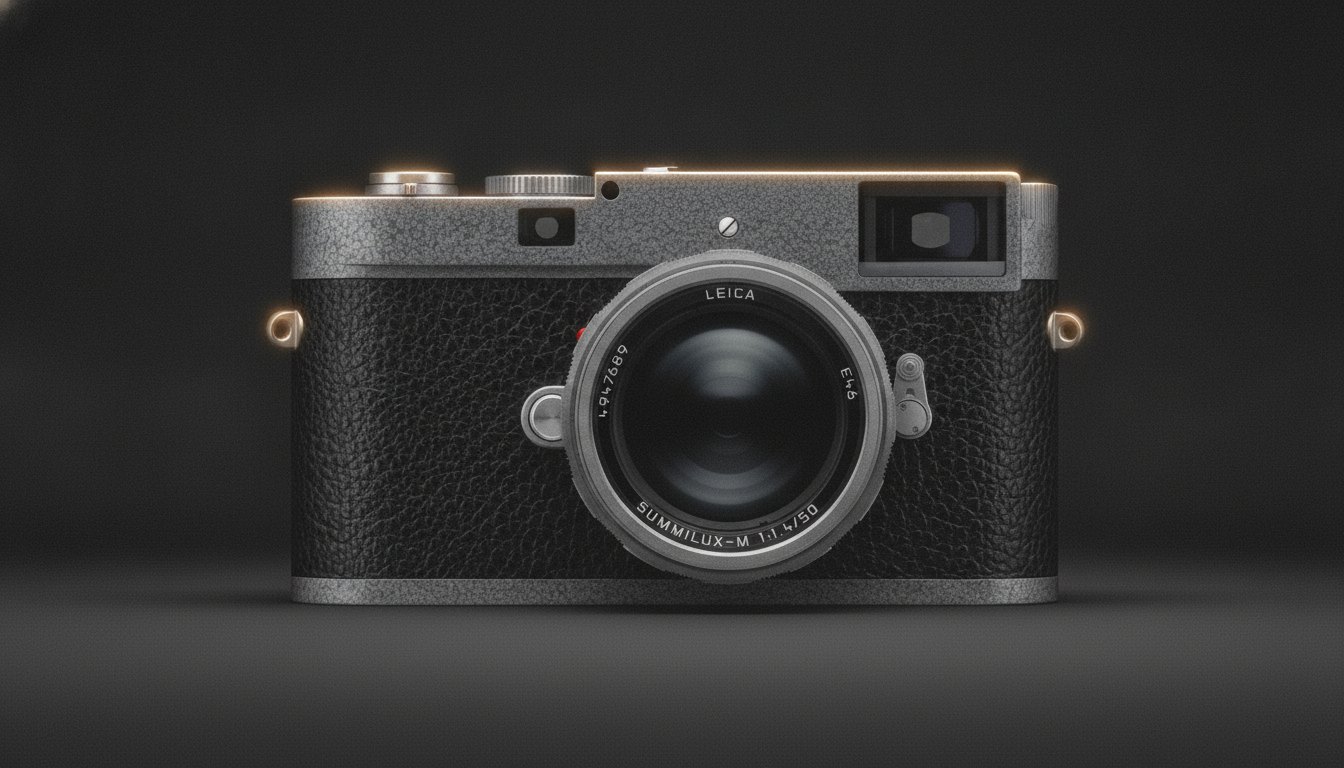
Leica has put its Hammertone finish, the textured grey crackle you see on old German lab kit and 1930s Leica accessories, on two cameras: the digital M11-P and the fully mechanical film M-A. Both went on sale on 12 November 2026 through Leica Stores, the Leica online store and authorised dealers.
The M11-P is the camera on my own wish list, so I read the announcement with my wallet closed and my eyes open. Here is what you get, what it costs, and where a cheaper rangefinder-style setup gets you most of the way.
What’s new
This is a finish, not a new camera. Inside, the M11-P Hammertone is the M11-P, and the M-A Hammertone is the M-A. The changes:
- Hammertone texture on the solid brass top and base plates. Leica says it reworked the process so the texture is more even, and that every camera’s pattern is unique.
- Cross-knurled controls and a shiny silver shutter-release plate.
- Black vulcanite-style leatherette with white engravings.
- On the M11-P only: rounded, classic edges on the top and base plates and a silver-chrome front screw. It looks closer to a film M than the standard M11-P does.
Price check
| Camera | Type | Price (USD) |
|---|---|---|
| Leica M11-P Hammertone | 60MP digital rangefinder | $10,950 |
| Leica M-A Hammertone | Mechanical 35mm film | $8,000 |
| Leica M11-P (standard, launch price 2023) | 60MP digital rangefinder | $9,195 |
| Nikon Zf (body, launch price 2023) | 24.5MP full-frame mirrorless | $1,996.95 |
Against the standard M11-P’s launch price, the Hammertone costs about US$1,750 more. That money buys looks and rarity, not image quality. Leica hasn’t said how many will be made.
How it compares to what I shoot
My daily camera is a Nikon Zf. With a Shoten LM-NZ E adaptor, M-mount glass goes on it, and my Voigtländer Nokton 40mm f/1.4 already gives me that small-rangefinder-lens feel. So the honest comparison isn’t Leica against nothing. It’s Leica against a Zf with an adaptor.
| Leica M11-P | Nikon Zf + M adaptor | |
|---|---|---|
| Focusing | Optical rangefinder patch; optional EVF | EVF with magnification and focus peaking |
| Resolution | 60MP (with 36MP and 18MP modes) | 24.5MP |
| Stabilisation | None in body | In-body, and you can enter the focal length for manual lenses |
| M lenses | Native, with 6-bit coding | Via adaptor; wide M lenses can show corner colour shifts on mirrorless sensors |
| Authenticity | Content Credentials built in | No |
| The feeling | The rangefinder experience itself | Rangefinder looks, mirrorless habits |
Ease of use
A rangefinder is slower by design. You line up the patch, you frame with bright lines, and you guess a little at the edges. That is exactly the appeal for street work: you see outside the frame and you commit. The Zf makes manual focus easier, especially at f/1.4, but it never feels like looking through a window.
The M-A goes further. It has no battery and no light meter, so it’s you, a film stock and sunny-16. My Canon QL17 GIII and Pentax Spotmatic F already scratch that itch for a fraction of the price.
Who it’s for
- Collectors and Leica regulars: it’s an easy buy if you’d have bought an M11-P anyway and want the one that ages best on a shelf and in the hand.
- Street and documentary shooters: the standard M11-P makes the same pictures for less.
- People like me who want the rangefinder look and glow: a Zf plus a fast M-mount or vintage lens gets 80% of the result for a fraction of the cost. The rangefinder itself is the 20% you pay for.
Customise it
The Hammertone is the customisation, so I wouldn’t touch the body. What I would do:
- Pair it with a small, older-design lens for the glow: a 35mm or 50mm with some spherical aberration wide open.
- Print a soft-touch thumb rest or a lens-cap holder in TPU instead of buying the official ones. I design this sort of thing in Shapr3D, and a camera’s top plate is easy to model from a few calliper readings.
bossLab verdict: beautiful, and it’ll hold its value better than most cameras. But it’s a finish, not a feature. If you want the M11-P, buy the one you’ll actually carry. If you want the look, a Zf with an M-mount adaptor and a vintage-character lens is the sensible way in. I still want one.
Sources: PetaPixel · Leica press release · Imaging Resource
Would you buy it, skip it, or wait for version two? Tell me in the comments below. I read every one.