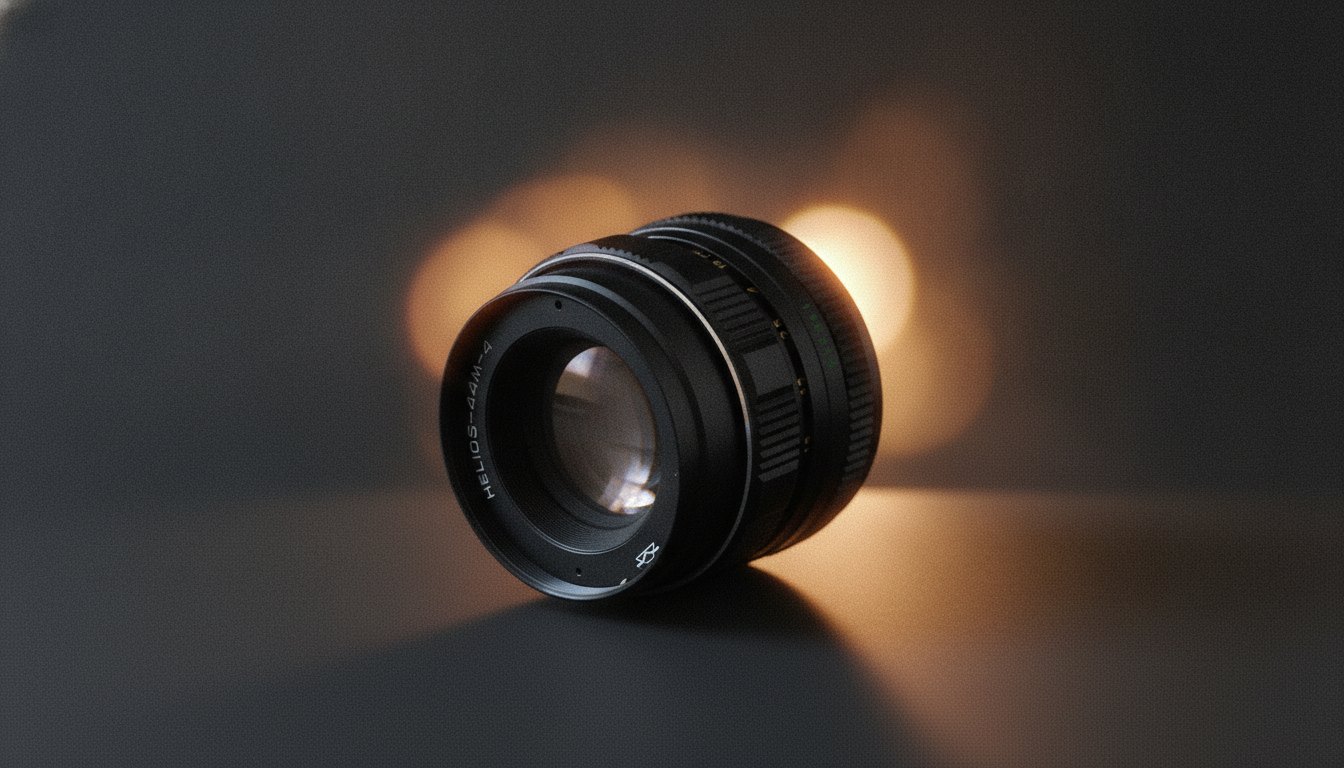
Modern lenses are nearly perfect, and that’s exactly the problem. Sharp to the corners, contrasty, clinical. I keep reaching for old glass on my Nikon Zf because of one thing: glow. Highlights bloom, skin softens, backlight turns into atmosphere. Here’s what actually causes it, how the lenses in my bag compare, and how to set up the Zf so manual focus is enjoyable.
Why old lenses glow
- Spherical aberration: many older fast designs aren’t fully corrected wide open. Light from the edges of the lens focuses slightly differently from light through the centre, laying a soft halo over a sharp core. Stop down two stops and it mostly disappears, which means you get two lenses in one.
- Older coatings: less effective coatings mean more internal reflections, lower contrast and flare that blooms rather than ghosts.
- Field curvature and busy bokeh: the famous Helios “swirl” comes from how the out-of-focus highlights stretch towards the frame edges.
How my lenses compare
| Lens | Mount / adaptor | Character wide open | Best for | Cost to get in |
|---|---|---|---|---|
| Helios 44M-4 58mm f/2 | M42 via Shoten M42–NZ | Strong swirl, soft glow, flares easily | Portraits with busy green backgrounds, botanicals | $ |
| Carl Zeiss Jena 58mm f/2 | M42 | The design the Helios copied; refined swirl, gentle glow | Same jobs, a touch more polish | $$ |
| Super-Takumar 55mm f/1.4 | M42 | Creamy glow, warm rendering | Low light, street at night, skin | $$ |
| Super-Takumar 105mm f/2.8 | M42 | Gentle, low-contrast classic portrait look | Head-and-shoulders, flowers from a distance | $ |
| Voigtländer Nokton 40mm f/1.4 | Leica M via Shoten LM–NZ | Glow wide open, crisp by f/2.8; tiny | Everyday street, the “rangefinder lens” feel | $$$ |
| Viltrox 35mm and 85mm EVO | Native Z, autofocus | Modern, clean, contrasty | When I need autofocus and certainty | $$ |
A note on the Super-Takumar 55mm f/1.4: many copies contain thoriated glass elements that yellow with age and give a warm cast. Leaving the lens in sunlight or under UV light usually clears much of the yellowing. Some people love the warmth, and a white-balance tweak in post fixes it anyway.
Ease of use: setting up the Zf for manual glass
- Enter non-CPU lens data (focal length and maximum aperture) in the setup menu. In-body stabilisation then works properly, and the EXIF shows which lens you used.
- Turn on focus peaking at low sensitivity, and map magnification to a button for critical focus wide open.
- Shoot in aperture priority with auto ISO. The Zf meters through the lens, so nothing changes from how you’d shoot a native lens.
- Use the EVF, not the screen, for f/1.4 and f/2. Peaking is more trustworthy at eye level.
Adaptors: price against quality
A cheap adaptor that isn’t machined accurately won’t reach infinity focus, or it will tilt the lens and soften one side of the frame. I use Shoten adaptors (LM–NZ E for M-mount, M42–NZ for screw-mount) because they’re precise and the fit is tight. For M42, check whether the adaptor has a pin pusher for lenses with an auto/manual aperture switch. On Takumars, set the switch to manual.
Use cases
- Botanicals and macro-ish work: the Helios swirl behind a single flower is hard to beat, which is why so much of my Lumina Flora Studio work started on old glass.
- Street: the Nokton 40mm on the Zf is the closest I get to a rangefinder without buying one.
- Portraits: the Takumar 105mm f/2.8 flatters skin without any filters.
Customise it
- 3D-printed lens hoods fitted to vintage filter threads: design in Shapr3D, print in matte black PETG, and flock the inside.
- Focus tabs printed in TPU make manual focus faster, especially on small lenses like the Nokton.
- Rear-cap holders and a printed lens-cap clip for adaptor swaps in the field.
bossLab verdict: if you want the vintage glow on a Zf, start with a Helios 44M-4 and a good M42 adaptor. It’s the cheapest way to see if you love it. If you do, a Super-Takumar 55mm f/1.4 and a compact M-mount Nokton complete the kit. Keep one modern autofocus prime for days you can’t afford to miss.
References: Nikon Zf reference manual (non-CPU lens data, focus peaking) · Voigtländer
Would you buy it, skip it, or wait for version two? Tell me in the comments below. I read every one.