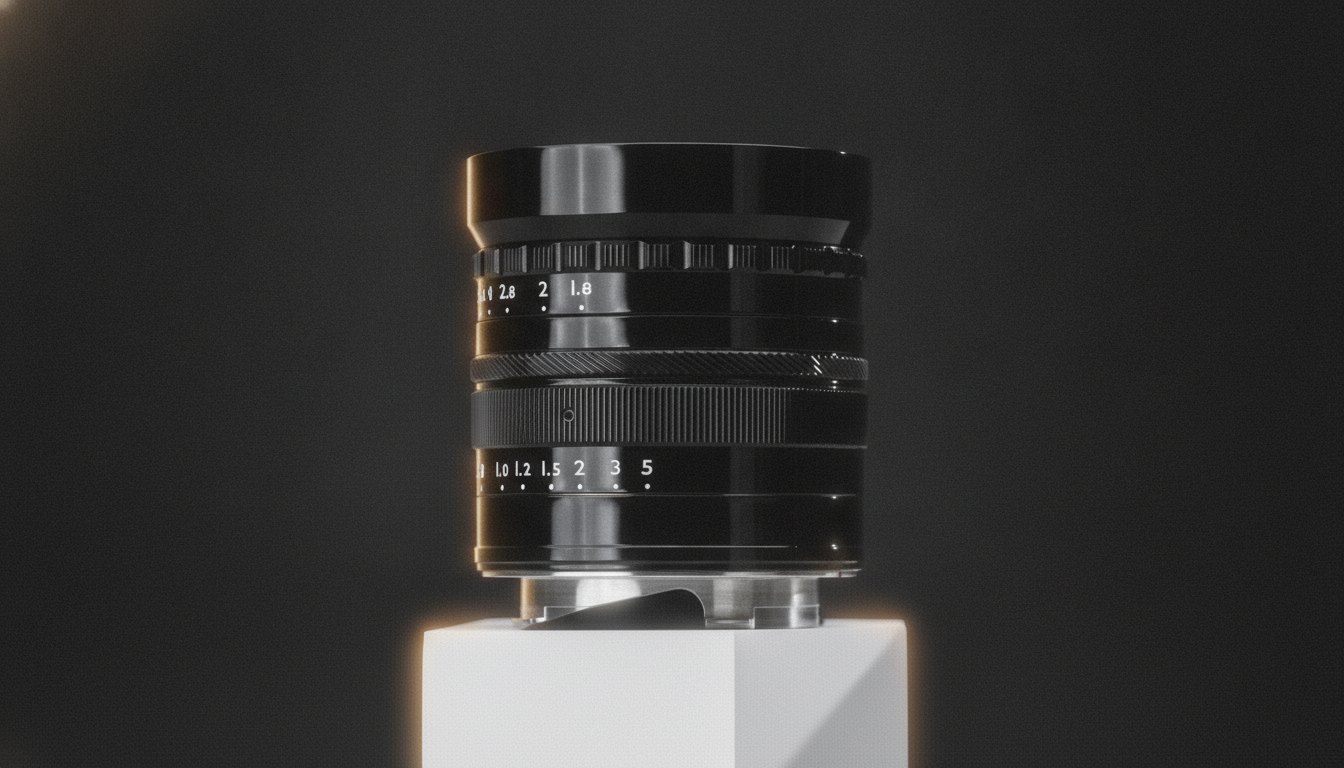
The DK-Optic Belladonna 50mm f/1.4 is the most interesting lens announced this month, and also the most expensive. It is a new Leica M-mount lens built as a homage to the Boyer Paris Saphir 50mm f/1.4, a rare French double-Gauss that collectors chase at auction. The asking price is US$7,000. I shoot a lot of old 50s for the glow, so I wanted to work out, on paper, what that money buys and whether there is a smarter way to get the look.
What’s new with the DK-Optic Belladonna 50mm f/1.4
DK-Optic is the small maker behind the Chiaro series and the Impastolite, lenses that recreate the character of classic optics in new metal. The Belladonna showed up on Leica Rumors on 16 November 2026, and the official product page lists it at US$7,000 in black, marked out of stock when I checked.
- The design: a classic 6-element, 4-group double-Gauss, the same family as the Boyer Saphir it honours.
- The aperture: 18 blades, stepless (declicked) with what DK-Optic calls cinema-grade damping. Eighteen blades is a lot, and it should keep out-of-focus highlights round when you stop down.
- The coverage: full frame, and DK-Optic says it also covers 44 x 33mm medium format.
- The look: DK-Optic promises soft portrait rendering, gentle contrast, layered bokeh and highlights that glow. Leica Rumors adds pale halation and flare against the light, and denser colour once you stop down.
That last point matters. Most vintage-style lenses are soft and glowy wide open and then sharpen up a couple of stops in. That is exactly how my Helios and Zeiss Jena behave, and it is the useful kind of character: you pick the amount of glow with the aperture ring.
Specs
| Spec | DK-Optic Belladonna 50mm f/1.4 |
|---|---|
| Mount | Leica M |
| Optics | 6 elements, 4 groups, double-Gauss |
| Aperture | f/1.4 to f/11, 18 blades, stepless |
| Closest focus | 0.55m (rangefinder coupled from 0.7m) |
| Filter | 46mm on the lens, 49mm inside the hood |
| Hood | Brass, black paint, included |
| Weight | About 310g |
| Size | About 54 x 44mm |
| Price | US$7,000 |
DK-Optic does not publish special glass types, coatings or an MTF chart, and there is no shipping date on the page yet. Between 0.55m and 0.7m the rangefinder is not coupled, so on an M body you focus that close range with Live View.
How it compares
The fairest rival announced the same week is the Light Lens Lab 40mm f/2 “Hua” (Leica Rumors calls it “Hana”). It is also a 6-element, 4-group double-Gauss, but Light Lens Lab builds it with restored and recoated elements salvaged from vintage lenses, inspired by the 40mm f/2 lenses on 1980s Chinese rangefinders. It costs US$250 on the official site, with shipping from December 2026. Light Lens Lab is upfront that the salvaged glass varies, so two copies can render differently.
| Lens | Price | Aperture / blades | Weight |
|---|---|---|---|
| DK-Optic Belladonna 50mm f/1.4 | US$7,000 | f/1.4, 18 blades | 310g |
| Light Lens Lab 40mm f/2 Hua | US$250 | f/2, 10 blades | 162g |
Then there is the glass already in my bag. I compared my old 50s on the Zf in my vintage glow test of Helios, Takumar, Zeiss Jena and Nokton lenses on the Nikon Zf, and the Helios 44M-4 and Carl Zeiss Jena 58mm f/2 are double-Gauss designs too. They will not render like a Saphir, but they show you what the formula does wide open for a tiny fraction of the cost. My Super-Takumar 55mm f/1.4 gives a warmer, gentler version, and the Voigtländer Nokton 40mm f/1.4 is the one I reach for when I want a little glow without losing the subject.
Where the Belladonna separates itself is the combination: f/1.4, 18 blades, a proper M-mount rangefinder cam and a new, consistent build. Vintage Saphirs are scarce, often decades old, and come with whatever haze or cleaning marks their life gave them.
Price check
- DK-Optic Belladonna: US$7,000 direct from DK-Optic. Leica Rumors lists a code for US$100 off on the official store.
- Light Lens Lab 40mm f/2 Hua: US$250, shipping from December 2026.
- An original Boyer Saphir 50mm f/1.4: Leica Rumors says originals are scarce and often fetch high prices at auction. I won’t quote a figure, because auction results swing wildly with condition.
I found no Malaysian retailer listing yet, so no RM price. For context, US$7,000 is getting close to Leica body money, and a Leica M11-P is the camera I keep saying I’ll buy one day (I covered the M11-P Hammertone edition and what its money buys last week). Spending that on one character lens before you own the body is the wrong order for most people.
Ease of use
On a Leica M it is simple: rangefinder focus from 0.7m to infinity, Live View for the last bit to 0.55m. The stepless aperture is lovely for video and a little slower for stills, because you can’t count clicks by feel.
On my Nikon Zf it would go on the Shoten LM–NZ E adaptor, the same way my Nokton does. You lose the rangefinder cam, of course, and focus with magnification and peaking, which the Zf does well. At 310g it balances nicely on that body. The real issue with glowy lenses on a mirrorless EVF is that the glow can fool focus peaking wide open, so I’d zoom in to confirm rather than trust the outline.
Who it’s for
- Buy it if: you shoot an M body, love portrait work with soft highlights, and want the Saphir look in a lens that is new, serviceable and consistent.
- Buy it if: you shoot video and like a declicked iris with a round aperture at every stop.
- Skip it if: you want sharpness wide open, or you mostly shoot landscapes and street at f/8, where most of its character is gone.
- Skip it if: you haven’t tried a cheap double-Gauss yet. Buy a used Helios 44M-4 first and find out whether you even like the look.
Customise it
There isn’t much to modify on a lens like this, and I wouldn’t open it. The useful maker projects sit around it:
- A fitted case insert: model the 54 x 44mm body and hood in Shapr3D, subtract it from a block, and print the insert in TPU so the lens and adaptor sit snug in a camera bag.
- An adaptor keeper: a small printed holder that clips to a strap and stores an M rear cap or a spare adaptor, handy when you swap between M42 and M glass on the Zf.
- Filters for more glow: a 46mm diffusion or black mist filter lets you push the halation further, and the 49mm thread inside the hood is another option.
If you design accessories like these to sell, my notes on the Shapr3D features that help you design prints people buy are a good starting point.
Quick answers
How much is the DK-Optic Belladonna 50mm f/1.4?
US$7,000 on DK-Optic’s official store, in black. It was listed as out of stock when I checked, and no shipping date has been published yet.
What lens is the Belladonna based on?
It pays homage to the Boyer Paris Saphir 50mm f/1.4, a rare French 6-element, 4-group double-Gauss lens known for its characterful rendering. DK-Optic hasn’t said how closely the new formula follows the original.
Can you use Leica M lenses on a Nikon Zf?
Yes, with an M to Z adaptor such as the Shoten LM–NZ E. Focus is manual with magnification and peaking, and you lose rangefinder coupling, which only matters on an M body anyway.
Is there a cheaper way to get vintage glow?
Yes. Old double-Gauss lenses like the Helios 44M-4 or Carl Zeiss Jena 58mm f/2 give soft, glowing highlights wide open for very little, and the Light Lens Lab 40mm f/2 Hua does it in M mount for US$250.
bossLab verdict: On paper the DK-Optic Belladonna 50mm f/1.4 is a beautifully specified character lens: 18 blades, rangefinder coupling, a brass hood and the Saphir glow without the auction gamble. But at US$7,000 it is a luxury for M shooters who already know they love this look. Everyone else should try a Helios or the US$250 Light Lens Lab Hua first, and I’d want to see independent full-resolution samples before I took it seriously as a Saphir replacement.
Sources: DK-Optic Belladonna product page, Leica Rumors: Belladonna announced, Light Lens Lab 40mm f/2 Hua, Leica Rumors: Light Lens Lab 40mm f/2.
Would you buy it, skip it, or wait for version two? Tell me in the comments below. I read every one.