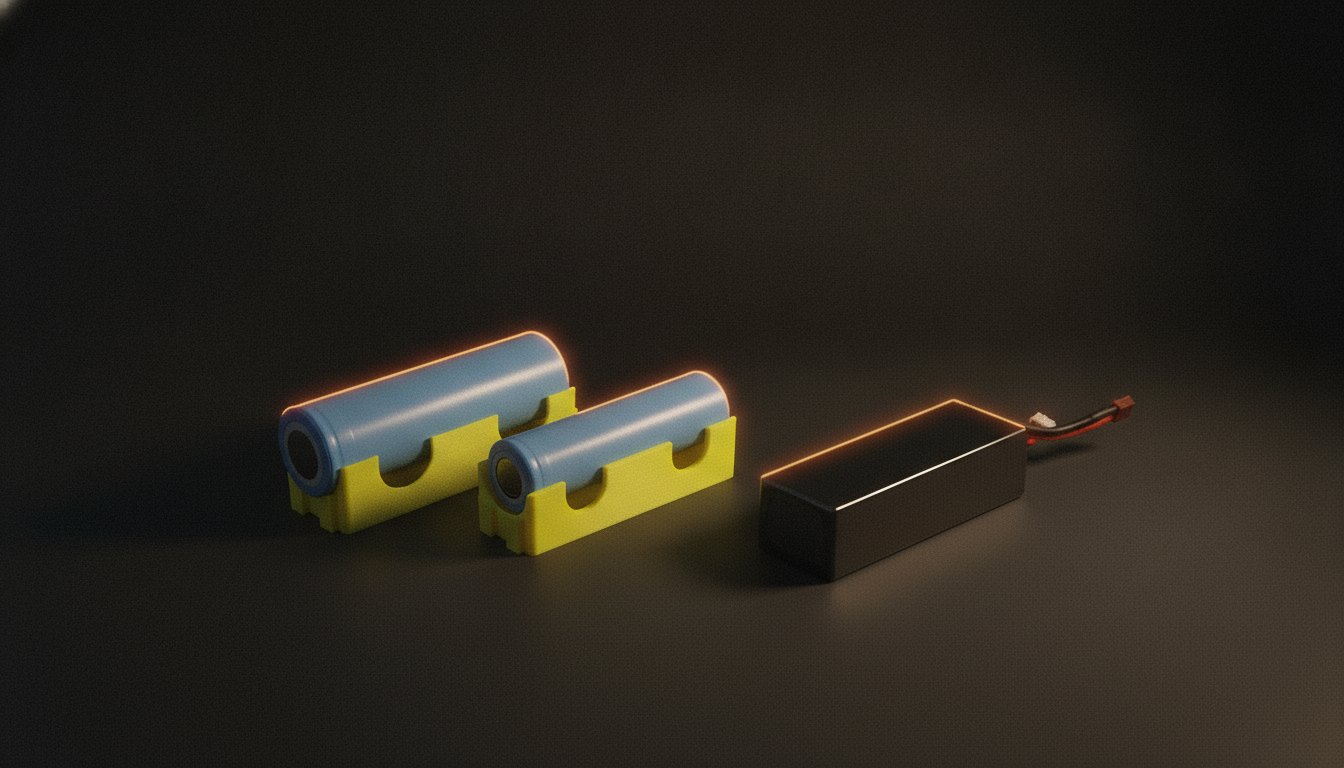
Every long-range build eventually raises the same question: LiPo or Li-ion? They’re both lithium chemistries, but they’re built for different jobs. Here’s how I decide.
The short version
- LiPo: huge bursts of current, lower energy per gram. Built for punch: freestyle, racing, bashing, aerobatics.
- Li-ion (18650, 21700 cells): much more energy per gram, much lower safe current. Built for steady cruising: long-range quads, wings, endurance.
How they compare
| LiPo pack | Li-ion pack (18650/21700) | |
|---|---|---|
| Energy per gram | Lower | Higher, often well over a third more per pack weight |
| Burst current | Very high | Low to moderate; heavy throttle sags the voltage |
| Voltage under load | Stays up | Sags more when pushed |
| Safe minimum voltage | About 3.5V per cell under load | Lower, often around 2.8 to 3.0V per cell depending on the cell |
| Physical toughness | Soft pouch, puffs and dents | Steel cans, tougher |
| Lifespan | Shorter if abused | Usually more cycles |
| Best for | Freestyle, racing, bashing, 3D flying | Long-range quads, wings, crawlers, cruising |
Always check your actual cell’s datasheet: continuous current rating and minimum voltage vary a lot between cell models.
Use cases
- Freestyle and racing quads: LiPo. Li-ion can’t deliver punch-outs without sagging.
- 7-inch long-range and cinematic cruising: Li-ion, often doubling flight time at gentle throttle.
- Fixed wings on INAV: Li-ion. Wings cruise at low current, the ideal case.
- Bashers like the new Traxxas VX-3 trucks: LiPo. High current, lots of punch.
- Rock crawlers: Li-ion works well. Low current, long sessions.
Ease of use: what changes when you switch
- Set your low-voltage warnings for the chemistry. A LiPo warning at 3.5V will cut Li-ion sessions short; a Li-ion warning at 3.0V will murder a LiPo. Betaflight 2026.6’s battery profiles let you keep both on one quad and switch from the radio.
- Fly differently: smooth throttle on Li-ion, no punch-outs.
- Charge at the right voltage: most cells are 4.2V full; some LiPos are LiHV (4.35V). Never charge a standard cell as HV.
Customise it
- Build your own Li-ion packs only if you can spot-weld properly and fit a balance lead. Never solder directly to cells.
- Print battery pads and straps in TPU to protect packs from vibration and arm impacts.
- Fireproof storage: a metal ammo box (with the seal removed so pressure can escape) or a proper LiPo bag. That’s non-negotiable whichever chemistry you choose.
bossLab verdict: pick by how you fly. Punch needs LiPo, distance needs Li-ion. On a long-range quad, keep one LiPo for when you want to play and a Li-ion for when you want to go far, with a battery profile for each.
References: Oscar Liang: Betaflight 2026.6 battery profiles · cell manufacturers’ datasheets for your specific cells
Your take
Would you buy it, skip it, or wait for version two? Tell me in the comments below. I read every one.