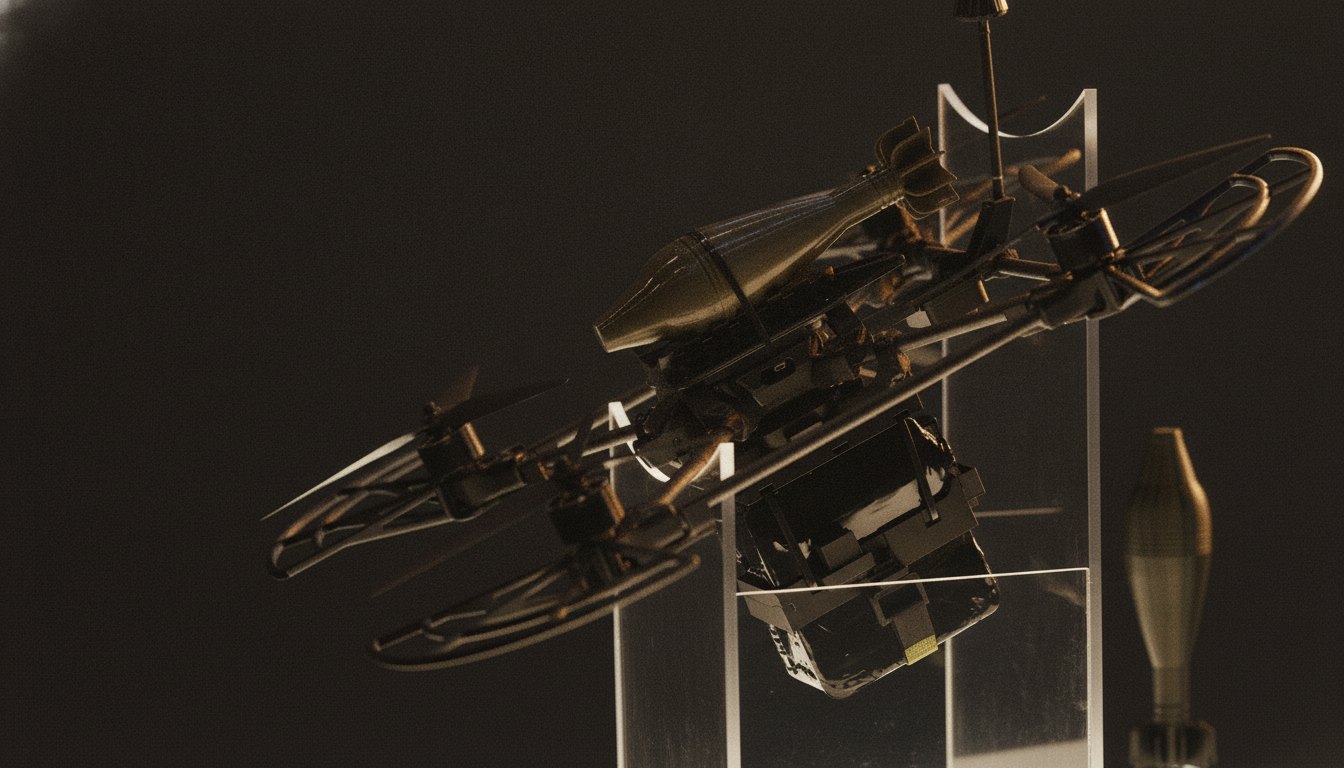
Drop the empty battery, fly 15% further: the physics behind Stellarion’s staged FPV drones
Rockets drop their empty stages. Ukrainian defence company Stellarion has done the same thing with FPV drones. On 20 November 2026 it announced a battery jettison system for its radio-controlled Deadliner R-series: the drone carries two batteries and drops the first once it’s spent. By the company’s own calculations, that adds about 15% range, even after carrying the release mechanism.
The context is war, and I’m not going to pretend otherwise. But the engineering question underneath is one every long-range hobby pilot has wrestled with: how do you carry more energy without the extra weight eating the gain?
What was announced
| Model | Frame | Stated range |
|---|---|---|
| Deadliner R10 | 10-inch | Up to 50 km |
| Deadliner R15 | 15-inch | 70 to 80 km |
Stellarion says it builds more than 30 strike UAV variants, both radio-controlled and fibre-optic, and claims a capacity of 40,000 units a month. The 15% figure is the company’s estimate and hasn’t been independently tested.
Why the physics works
A multirotor pays to hold itself up every second it’s airborne. From basic rotor (momentum) theory, the power needed to hover rises faster than weight: roughly with weight to the power 1.5. So a drone that’s 20% lighter needs noticeably more than 20% less power to stay up.
A battery is heaviest relative to the energy left in it when it’s nearly empty. Carrying a dead pack for the second half of a flight is pure penalty: full weight, zero contribution. Drop it, and every remaining watt-hour goes further. The catch is the mechanism’s own weight and complexity. A 15% net gain is plausible for a heavy 10 to 15-inch airframe, where the battery is a big share of take-off weight.
How it compares with other ways to fly further
| Approach | Range gain | Complexity | Hobby-friendly? |
|---|---|---|---|
| Bigger single battery | Diminishing; weight cancels capacity | Low | Yes |
| Li-ion pack instead of LiPo | Large, at cruise power | Low | Yes, the long-range standard |
| Efficient props and motors, cruise tuning | Moderate | Medium | Yes |
| Fixed wing instead of quad | Very large | Medium | Yes (INAV) |
| Staged battery jettison | About 15% (claimed) | High | No, dropping objects is a safety and legal problem |
What hobby pilots can take from it
Don’t drop batteries over people’s heads, obviously. Here in Malaysia, CAAM rules also restrict dropping anything from a drone. The lesson is energy density per gram:
- Li-ion for cruising: 18650 or 21700 packs hold far more energy per gram than LiPo at gentle cruise currents. That’s why long-range 7-inch builds run them.
- Cut every gram you print: design mounts and canopies in Shapr3D with ribs instead of solid walls, and print in lightweight or CF-filled filaments. Grams add up over a 30-minute flight.
- INAV for distance: GPS rescue, return-to-home, cruise mode and live mAh-per-km readouts are what make long flights safe. Betaflight’s GPS rescue is a safety net, but INAV is built for navigation.
- Consider wings: a fixed-wing on INAV will out-range any quad on the same battery.
The bigger picture
Ukraine has turned hobby FPV hardware into the fastest-moving drone development programme in the world. Fibre-optic control to beat jamming, staged batteries, mass production at tens of thousands of units a month: many of these ideas will filter back into civil long-range, mapping and inspection drones, just as GPS rescue and digital video did.
bossLab verdict: clever, simple physics, and a reminder that weight is the enemy of range. For hobby flying, get the same lesson the legal way: Li-ion packs, lighter printed parts and INAV.
Sources: DroneXL · Civil Aviation Authority of Malaysia
Would you buy it, skip it, or wait for version two? Tell me in the comments below. I read every one.